



Every solar quote comes with a bold promise about savings. The real numbers rarely match the sales pitch, though. Before you sign anything, you need an honest solar panel roi calculation based on your actual energy use, not a generic estimate. Here’s the catch: the best return starts with shrinking your home’s energy demand first. That’s where a proper energy audit and a few overlooked upgrades come in, long before a solar contractor ever touches your roof.
What to Know Before You Calculate Solar Panel ROI
ROI vs. payback period: what’s the difference
Payback period is simple. It’s how many years it takes for the savings on your electric bill to equal what you spent installing the system. If your panels cost $18,000 and save you $1,800 a year, you’re looking at a 10-year payback. That’s it. No compounding, no growth, just a break-even point marked on a calendar.
ROI, or return on investment, is the bigger picture. It accounts for the full lifespan of the system, usually 20 to 25 years. It factors in things payback ignores: rising utility rates, equipment degradation, maintenance costs, and any incentives you claimed upfront. Two systems can have the same payback period and wildly different ROI numbers once you run the math out further. That distinction matters a lot when you’re comparing quotes.
Here’s the blunt version: payback tells you when you stop losing money. ROI tells you how much you actually gain. Confusing the two is how homeowners end up disappointed five years in.
Why your home’s energy use is the real starting point
Before any of that math means anything, you need real numbers. Pull twelve months of utility bills, not three. Energy use swings hard between January and July, and a short sample will skew your baseline. You’ll also want basic roof and home details: square footage, roof angle, shading, and your panel or breaker capacity, since older electrical setups sometimes need attention before solar gets added.
This is where a lot of ROI estimates go wrong from the start. A solar contractor will size a system to your current usage, not your reasonable usage. If your home is leaking energy through drafty windows, an old fridge, or a boiler running harder than it should, you’ll end up paying to generate power that’s covering waste, not need. Cutting that waste first, through things like sealing air leaks or swapping out a failing appliance, can shrink the system size you need and the upfront cost with it. That changes the entire payback calculation in your favor.
That’s why a home energy audit belongs before the solar conversation, not after. An audit establishes your actual baseline load, the number solar should be sized against, rather than the inflated one your current bills reflect. If you’re researching options in the area, understanding what a solar panel service near me pine brook search actually turns up can help you compare how contractors approach sizing and pricing before you commit to a quote.
Step 1: Reduce Your Home’s Energy Load Before Sizing a System
What an energy audit reveals about your usage
Plenty of oversized solar quotes trace back to one skipped step: nobody measured the actual load first. A contractor eyeballs your last few utility bills, assumes your usage is fixed, and sizes a system around waste you could’ve eliminated. An energy audit fixes that. It uses blower door tests, thermal imaging, and appliance-level data to show exactly where your home is bleeding energy — drafty doors, a thin attic, an ancient water heater running longer than it should.
That detail matters because every kilowatt you don’t need is a kilowatt you don’t have to pay to generate. A home leaking heat through gaps and poor insulation might show a usage profile that’s 20-30% higher than it needs to be. Skip the audit, and you’re sizing solar to cover waste instead of real demand.
Attic insulation, caulking, and weatherstripping directly attack the biggest chunk of that waste: heating and cooling loss. A poorly insulated attic can account for a huge share of winter heat loss, since warm air rises and escapes through the roof. Sealing gaps around doors, windows, and trim stops the sneaky drafts that make your furnace or AC run longer than necessary. Together, these upgrades lower the heating and cooling demand your future solar system would otherwise need to offset, and they’re a fraction of the cost of oversizing an array to compensate.
How LED bulb replacement and efficient appliances lower baseline usage
Beyond heating and cooling, your baseline electric draw matters just as much. Older incandescent and halogen bulbs burn far more energy than modern alternatives. If your home still has a mix of them, that’s steady, all-day consumption adding up on every bill. Swapping them out is one of the cheapest, fastest ways to shave off baseline load before anyone talks panel count. In fact, led light bulb replacement can cut lighting-related electricity use dramatically, and it’s a same-day fix, not a renovation.
Outdated appliances tell a similar story. A refrigerator or dishwasher from a decade or two ago can use noticeably more electricity than a current efficient model. Replacing tired appliances — alongside fixture-level fixes like showerhead and aerator swaps that reduce hot water demand — trims the everyday draw a solar system would otherwise need to cover. Add it up, and you might genuinely need fewer panels than the first quote suggested.
Why a smaller, right-sized system improves ROI by lowering upfront cost
Here’s the blunt truth: a bigger system isn’t a badge of honor. It’s just more money spent upfront, and if your usage doesn’t justify it, that extra capacity sits there paying you back slowly, if at all. Right-sizing means your solar investment matches real, reduced demand — not inflated demand from a leaky, inefficient house. That’s the difference between a payback period measured in years you can actually plan around.
A right-sized system also means less roof space consumed, potentially fewer inverters, and a lower total installed cost relative to production. For homeowners comparing options, reviewing our services for load-reduction work before calling a solar installer is the practical first move. It’s a smaller check to write now, and a faster payback later. Efficiency first, panels second — that order rarely fails you.

Step 2: Gather the Numbers You’ll Need for the Calculation
Before you can run any real payback math, you need actual numbers, not guesses. Pull twelve months of utility bills, not three. Usage swings a lot between January and July, and a short sample will throw off every projection downstream. This is the boring part. It’s also the part that decides whether your ROI estimate is useful or fiction.
- Your average monthly kWh usage from a full year of bills, since seasonal swings in heating and cooling load can shift consumption by 50% or more between months.
- Your current electricity rate per kWh and the utility’s typical annual rate of increase, usually somewhere between 2% and 5%, which compounds significantly over a 20-year system life.
- A total system cost estimate before any incentives, including panels, inverters, wiring, permitting fees, and labor, gathered from at least two or three quotes.
- Estimated annual energy production based on your region’s sun hours and your roof’s orientation, pitch, and shading, which a contractor can model with tools like PVWatts or Aurora Solar.
- Every applicable incentive, including state rebates, utility-specific programs, and net metering rules, since these vary widely from town to town in New Jersey.
- The federal solar tax credit rate for the year you install, since it steps down over time and materially changes your net cost.
Before you commit to any of this, it’s worth revisiting whether are solar panels worth it for your specific roof and budget, since not every home has the right conditions for a fast payback. And if your production estimate leans on climate data, comparing sun-hour patterns across regions, similar to how installers evaluate conditions in st. lucie county or your own zip code, helps you sanity-check the contractor’s numbers instead of just accepting them.
Step 3: Calculate Your Solar Payback Period
Once you know your net system cost and your annual electricity savings, the math is simple. Payback period equals net system cost divided by annual savings. That’s it. The tricky part is being honest about the inputs, since a rosy savings estimate makes the payback look better than it really is.
Simple payback period example
Say a system costs $22,000 before incentives. After the 30% federal tax credit, your net cost drops to $15,400. If the panels save you $1,800 a year on electricity, here’s how that plays out over time.
| Scenario | Net Cost | Annual Savings | Payback Period |
|---|---|---|---|
| No tax credit | $22,000 | $1,800 | 12.2 years |
| With 30% federal credit | $15,400 | $1,800 | 8.6 years |
| With credit + rate increases | $15,400 | $1,800 (avg. rising) | ~7.3 years |
| With credit + local rebate | $13,900 | $1,800 | 7.7 years |
Notice how much weight that tax credit carries. Shaving $6,600 off the upfront cost cuts nearly four years off the payback in this example. That’s the single biggest lever most homeowners can pull, and it’s why filing for it correctly matters as much as picking the right panels.
Adjusting for utility rate increases
A flat $1,800 savings figure assumes electricity prices never move. They do, almost always upward, historically averaging 2-4% a year. If your savings grow with rates instead of staying fixed, your real payback lands sooner than the static formula suggests. Building that assumption into your model, even conservatively, gives a more honest number. It’s also worth remembering that panels lose a small percentage of output each year, so the two trends partly offset each other. For a fuller picture of long-term costs, it helps to review solar energy maintenance costs, since upkeep expenses factor into the true payback timeline too, not just the sticker price and the electric bill.

Step 4: Calculate True Solar Panel ROI
The basic math is simple: ROI equals net lifetime savings divided by net system cost, times 100 for a percentage. If a $22,000 system (after incentives) saves you $44,000 in electricity over 25 years, that’s a 100% ROI. Easy, but not the full picture — that number ignores when the money actually arrives.
Simple ROI treats every dollar saved the same, whether it lands in year one or year twenty. IRR (internal rate of return) accounts for timing, so it’s a more honest way to compare solar against other places you could park $22,000. Most people don’t do this by hand. A spreadsheet’s IRR function, fed with your upfront cost as a negative number and each year’s net savings after it, will spit out an annualized return you can actually trust for a multi-year projection.
Battery storage complicates things fast. It adds cost, stretches the payback period, but also protects savings during rate hikes and outages. Before pricing hardware, reading a solar panel installation nj guide can help you understand how local incentives and net metering rules affect whether a battery pencils out at all. Here’s a rough comparison:
| Scenario | Upfront Cost | Payback Period | 25-Year ROI |
|---|---|---|---|
| Grid-tie, no battery | $20,000 | 7–9 years | 90–110% |
| Grid-tie + battery (1 unit) | $31,000 | 10–13 years | 70–90% |
| Grid-tie + battery (2 units, backup priority) | $42,000 | 13–16 years | 50–70% |
As a sanity check, stack that IRR against index funds, bonds, or paying down a mortgage early. Solar returning 8–10% annually holds up fine against the stock market’s long-run average. That’s the real test — not whether solar “saves money,” but whether it beats your next-best option.
Factors That Can Raise or Lower Your ROI
Not every solar installation pays back at the same speed, even with identical panels. A handful of variables push the math in your favor or work against it, and most homeowners never check them before signing a contract. Here’s what actually moves the needle.
- Local electricity cost and rate structure — a higher per-kWh rate, tiered pricing, or time-of-use billing changes what each kilowatt-hour of solar production is actually worth to you.
- Sun hours, roof orientation, and shading — a south-facing roof with no tree cover will out-produce a shaded, east-facing one by a wide margin, even with the same panel count.
- Equipment quality and warranty length — panels rated for 25 years and inverters backed by 10-to-12-year warranties tend to hold output longer than budget hardware that degrades early.
- DIY versus professional installation cost — self-installed kits cut upfront price but can void manufacturer warranties or trigger permitting headaches that erase the savings.
- Your home’s efficiency level going in — a leaky, poorly insulated house needs a bigger, pricier system to offset the same bill, which stretches payback time.
- Eligibility for local incentive programs — state rebates, federal tax credits, and utility programs can shrink your net cost significantly, and missing one is money left behind.
Why efficiency upgrades outperform oversizing a system
Here’s the blunt truth: buying more panels to cover a wasteful house is throwing good money after bad. It’s cheaper to shrink the load than to power it. A home that leaks air through old caulk and thin attic insulation forces a solar system to work overtime just to break even, which means a bigger, more expensive array and a longer wait for payback. Tightening the building envelope first — sealing gaps, upgrading insulation, swapping in efficient fixtures — lowers the baseline usage a system needs to cover. Reviewing projects to improve energy efficiency before you size anything is a smart first move for most homeowners. Smaller systems cost less, install faster, and often pay back sooner. That’s not a guess; it’s basic math on kWh needed versus kWh produced.
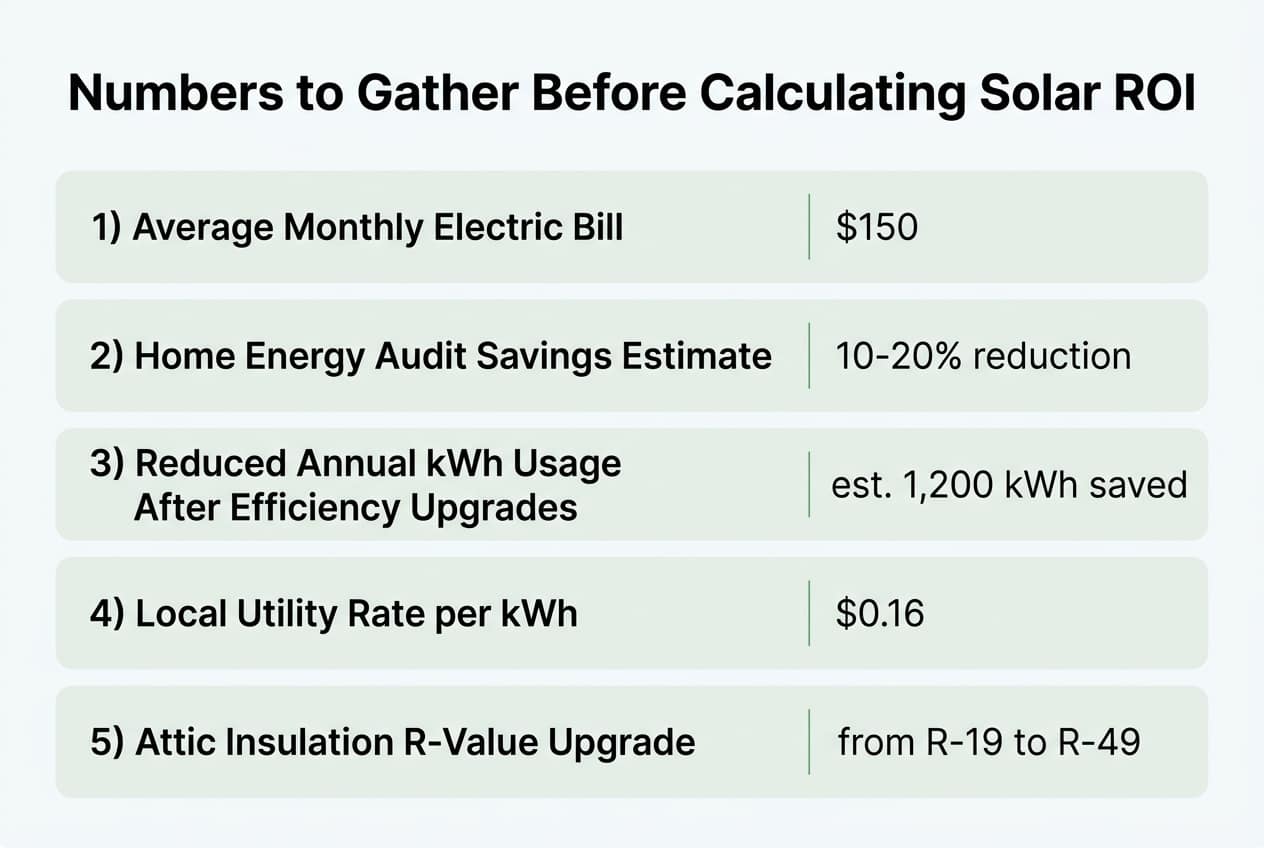
Step 5: Improve ROI Before and After Installation
Efficiency upgrades that pay off before solar goes on the roof
Solar math gets ugly fast if you’re paying to power a leaky house. Before a panel ever touches your roof, close the gaps that let heat escape and cold air sneak in. Sealing around doors, windows, and sill plates with caulking and weatherstripping shrinks the heating and cooling load your future system has to cover. Combine that with proper attic insulation, and you can often reduce the system size a solar installer recommends — which means fewer panels, lower upfront cost, and a shorter payback period. Smaller system, smaller bill, faster break-even. That’s the whole game.
Next, look at what’s actually eating electricity and gas day to day. An aging boiler, a water heater on its last leg, or a refrigerator from 2008 can quietly inflate your baseline usage no matter how much solar you install. Replacing tired appliances, water heaters, and boilers keeps that baseline demand low, so the solar output you generate covers more of your real need instead of chasing an inefficient system. Many local businesses skip this step and end up oversized on panels and underwhelmed on results.
Small fixture upgrades compound the savings, too. Old showerheads and faucet aerators waste hot water, which means wasted energy heating it. Swapping them, along with replacing outdated bulbs with LEDs, trims usage in ways that add up month after month. None of it is glamorous work. But a skilled team handling these smaller jobs correctly — sealing, fixture swaps, bulb changes — often has more impact on your monthly bill than people expect from something so simple.
If your household qualifies by income, some of this efficiency work may be available at no cost through the NJ Comfort Partners Program, which covers qualifying upgrades for eligible homeowners and renters. That changes the whole economics of a solar project, since you’re lowering your baseline load without spending a dime on the upgrades themselves. It’s worth checking eligibility before you assume you have to pay for every improvement out of pocket.
One more thing worth clarifying: efficiency contractors handle insulation, sealing, and appliance swaps — they don’t file your solar tax paperwork. Rebate forms and federal tax credit filings for the solar installation itself are handled by a tax professional or your solar installer, not the company doing your efficiency work. Keep those roles separate. Mixing them up is a common way people miss deadlines or forms entirely.
Putting It All Together: Your Solar ROI Checklist
Five steps, in order: audit your home, gather your energy numbers, calculate the payback period, work out true ROI, then keep improving it before and after installation. Skip a step and your math gets shaky. That’s the whole game, really — measure first, install second, tweak forever after.
Size matters more than people expect. A smaller, tightly sealed home with good attic insulation needs fewer panels to cover its load, which means less upfront cost and a faster break-even point. A drafty 3,000-square-foot house, by contrast, might need double the array just to offset its waste. That’s not a solar problem — it’s a leaky-envelope problem, and it’s worth fixing first. Readers weighing the bigger financial question of is solar cheaper than electric should know the answer shifts a lot once load is trimmed down.
Know who to call, too. An energy efficiency company handles audits, insulation, caulking, weatherstripping, and appliance swaps — the load-reduction side. A solar installer handles panels, inverters, and permitting. Bring in the installer only after the audit tells you what size system actually makes sense. Start with the audit, not the quote request. It’s the cheaper call, and it makes every solar quote that follows more accurate.
Deciding how to handle drafty windows or a leaky roof often comes down to fixing the source versus stopping the everyday waste around it — and both matter, just in different ways. A homeowner might reasonably ask a roofer or window contractor to handle the structural repair, then look separately at whether caulking, weatherstripping, and attic insulation are pulling their weight against heat loss. Weighing cost, timing, and what a skilled team can realistically improve in a single visit tends to bring the most efficient, least stressful path into focus.
