


Your electric bill keeps climbing, and now you’re wondering if there’s a better way. So you start asking the obvious question: is solar cheaper than electric in 2026? It’s not a simple yes or no. We’ll break down the real numbers so you can decide what actually makes sense for your home.
Is Solar Cheaper Than Electric? The Short Answer
Why this question is more complicated than it sounds
Here’s the quick version: solar usually wins over 15 to 20 years, but it costs more upfront than simply staying put on the grid. Panels, permits, and installation can run well into five figures before any credit or rebate kicks in. Your electric bill, on the other hand, costs you nothing to keep receiving. So the real question isn’t “which is cheaper” in some abstract sense. It’s how long you plan to stay in the house, and whether you can absorb the initial hit.
What tips the scale depends on four things: your utility’s rate per kWh, how much electricity your household actually burns through, how much usable sun your roof gets, and what incentives are on the table where you live. A home in a high-rate state with a south-facing roof and a hefty tax credit looks completely different, financially, than a shaded home in a state with cheap electricity. Anyone asking why is solar power not cheaper than regular electric power in their specific case is usually missing one of these four variables.
Framing the question right avoids the confusion most comparison articles create. They compare national averages, not your roof, your bill, or your rate. And before spending anything on solar, an energy audit often turns up cheaper fixes — attic insulation, caulking, weatherstripping — that lower your bill immediately, no panels required.
How Solar and Grid Electricity Actually Differ
What Solar Panels Produce vs. What Utilities Deliver
Solar panels make their own power. Sunlight hits the panel, gets converted to electricity, and either runs your home directly or gets stored for later. There’s no middleman. No wires stretching across town. No meter counting what you pull from somewhere else. It’s on-site generation, plain and simple. Grid electricity works the opposite way. A utility company generates power far away, often from a mix of gas, nuclear, or renewables, then delivers it through a massive infrastructure network of substations, transformers, and transmission lines.
That difference shapes the cost structure entirely. Solar demands a big check upfront, then costs you almost nothing to run for the next 20-plus years. Grid power flips that: no installation cost, but a bill every single month, forever. One recent industry report: Solar Power is Cheaper Than Ever found generation costs have dropped sharply over the past decade, which changes the math for a lot of homeowners.
Why Comparing Them Isn’t Apples-to-Apples
Here’s the problem with a straight price comparison: solar is a purchase, and electricity is a subscription. You’re comparing a fixed cost against a moving target. Grid rates rise with inflation, fuel costs, and seasonal demand spikes, especially in summer when everyone’s air conditioner runs nonstop. Reviewing practical energy saving tips for summer won’t stop rate hikes, but it softens their impact while you weigh bigger decisions like going solar.
Most homes don’t actually pick one or the other. Net metering lets you run on solar during the day and lean on the grid at night or during cloudy stretches, so you get a blended system rather than a clean either-or. It’s worth asking whether are solar panels worth it for your specific roof, usage, and rate plan before assuming either path is automatically cheaper. And don’t ignore the basics first — attic insulation, caulking, and weatherstripping often shrink your energy need before you ever add a panel.

Solar vs. Electricity Bill: Cost Comparison Table
What the numbers look like over 15 years
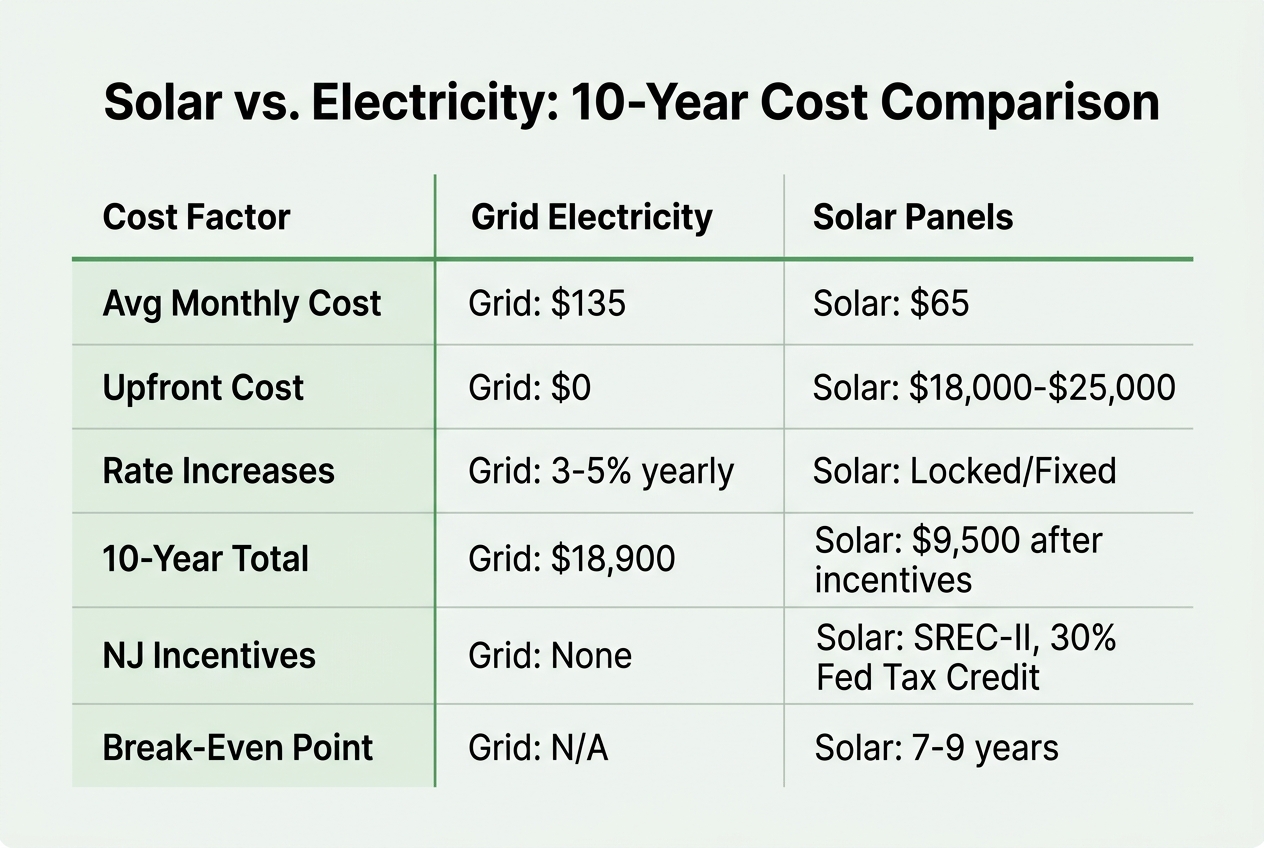
Numbers settle arguments. So here’s a straight side-by-side of solar and grid electricity across the factors that actually matter over a 15-year stretch: what you pay upfront, what you pay monthly, upkeep, how long the equipment lasts, and whether the price stays put or keeps climbing.
| Factor | Solar (After 30% Federal Tax Credit) | Grid Electricity |
|---|---|---|
| Upfront cost | $14,000–$21,000 for a typical 6–10 kW home system | $0 upfront |
| Monthly cost | $0–$40 (often just a grid connection fee) | $130–$300+, depending on rate structure and usage |
| Maintenance | $150–$300/year, plus occasional inverter replacement | None — costs are baked into the bill |
| Lifespan | 25–30 years, with gradual output decline | Indefinite, but rates rise every year |
| Price stability | Locked in once installed | Variable — tied to fuel costs and demand charges |
Electricity costs vary a lot by rate structure. Flat-rate plans keep things simple, but tiered and time-of-use plans can double your per-kWh cost during peak hours. Payback period for solar typically runs 6 to 12 years — faster for larger systems on high-usage homes, slower for small systems paired with modest bills. If you’re weighing the math for your own roof, this breakdown of solar power cost against standard utility rates lays out the assumptions clearly. One quiet cost people forget: upkeep. Panels need occasional cleaning and inspection, and finding reliable solar panel maintenance contractors is worth doing before you sign anything, not after something breaks.
Real Household Scenarios: Who Actually Saves With Solar
Numbers on a brochure don’t tell you much until you match them against a real bill. So let’s look at three households with different usage habits and see how the math actually plays out over time.
Low, medium, and high electricity users compared
A low-usage home, paying under $100 a month, often has too small a bill to justify the upfront cost of panels. There’s just not enough spend to offset. A medium-usage home in the $120 to $250 range tends to hit the sweet spot where system size, roof space, and savings line up cleanly. A high-consumption home above $300 a month usually sees the fastest payback, sometimes years faster than the low-usage example, because every kilowatt-hour offset is worth more against a bigger bill.
| Monthly Bill | Typical System Size Needed | Rough Payback Period | Best First Move |
|---|---|---|---|
| Under $100 | 2-3 kW | 12-16 years | Attic insulation and LED swaps first |
| $120-$250 | 5-7 kW | 7-10 years | Energy audit to size the system right |
| $300+ | 8-12 kW | 5-7 years | Appliance efficiency check, then solar |
Notice the pattern: usage shapes the outcome far more than the sticker price on a solar quote. A homeowner obsessing over panel brands like Q Cells versus REC is skipping a bigger question: is your home even using enough power to make the investment pay off? Reviewing projects to improve energy efficiency before buying panels often reshapes the whole decision. For questions specific to your situation, the contacts page connects you with people who can walk through the numbers.
What Determines Whether Solar Wins in Your Situation
Utility rates and sunlight exposure
Your utility rate per kWh is the single biggest factor in how fast solar pays for itself. Pay a high rate and every panel works harder for you, dollar for dollar. Pay a low rate, and payback stretches out for years. It’s really that simple.
Sunlight matters just as much as price, though. Peak sun hours, roof pitch, and which way your roof faces all decide how much electricity your system actually produces, not just what’s printed on the spec sheet. A south-facing roof in full sun will crush a north-facing roof shaded by trees, even with identical panels. Before assuming solar makes sense, it’s worth reading real owner debates like Solar more expensive than monthly electric bill? to see how wildly results vary by home.
Roof condition and local policy factors
A cheap electric bill on paper doesn’t mean solar is cheap in practice. Physical and policy limits can quietly kill the math:
- Roof age matters a lot — putting panels on shingles that need replacing in five years means paying to remove and reinstall the whole array.
- Shading from trees or neighboring structures can cut production by a third or more, even on an otherwise well-oriented roof.
- Structural constraints, like an older roof frame or unusual pitch, can limit panel count or block installation entirely.
- Net metering policy in New Jersey determines how much bill credit you actually receive for excess power sent back to the grid, and that policy can shift.
- Panel degradation, roughly 0.5% per year, slowly chips away at output, while future utility rate hikes can just as easily swing the math back in solar’s favor.
If you’re weighing repair versus replacement on an aging system, checking guidance on the best solar panel repair companies helps you estimate whether fixing existing panels beats a full new install.
Why Your Electricity Bill Never Actually Hits Zero
How net metering works in practice.
Net metering sounds like a clean deal: your panels send extra power to the grid during the day, and the utility credits you for it. Those credits then offset the power you pull at night. It’s a fair trade in theory. But credits are not the same as cash back, and they don’t wipe your bill down to nothing. Most utilities still bill you monthly, even if that bill is mostly made up of fees rather than energy charges.
Here’s the part that catches people off guard. Grid connection fees, delivery charges, and various state and local taxes stick around no matter how much solar you produce. These are the cost of staying tied to the grid at all, and solar doesn’t touch them. So even a homeowner with a perfectly sized system might see a bill of $20 or $30 a month, forever, just for the privilege of being connected. That’s not a billing error. That’s just how the system works.
Some homeowners find this out only after installation, which leads to frustration that could’ve been avoided with a clearer conversation upfront about what net metering actually credits.
Nighttime and low-sun days still pull power from the grid unless paired with battery storage.
Panels don’t work in the dark. That’s obvious, but its financial impact often isn’t. Every evening, every cloudy stretch, every short winter day means your home leans on the grid again, drawing power at whatever rate your utility charges. Without a battery, your daytime surplus doesn’t carry forward physically. It just becomes a credit you draw down later. Research from outlets covering energy economics has shown that Wind and Solar Energy Are Cheaper Than Electricity from fossil fuel sources on a production basis, but that doesn’t erase the timing mismatch between when solar generates and when homes actually use power.
Battery storage closes that gap, but it’s a real added cost, often adding thousands to a project. Without it, you’re still a grid customer every single night. Understanding this upfront prevents the sting of “I have solar, why is there still a bill?” It’s a fair question. It just has a fixed-cost answer, not a solar one.
Small efficiency upgrades won’t replace a battery, but they shrink the gap batteries need to cover. Attic insulation, weatherstripping, and caulking around doors and windows all reduce how much heating and cooling your home demands after dark, which lowers how hard the grid has to work while your panels sit idle. Pairing solar with efficiency work, rather than treating it as a standalone fix, tends to produce the most realistic savings. Anyone curious about the broader philosophy behind that pairing can find more detail on an about us page describing how audits and upgrades are approached together.
Beyond the Bill: Other Financial Benefits of Going Solar
Incentives and long-term value beyond monthly savings.
Monthly savings only tell part of the story. There’s real financial value in going solar that shows up years down the road, not on next month’s bill. Some of it is about avoiding future pain. Some of it is about what a buyer will pay for your house later. And some of it is just peace of mind when the power flickers out. Worth weighing all of it before you decide.
- Utility rates have climbed steadily for two decades, and locking in your own generation shields you from whatever hikes come next.
- Homes with owned solar systems often sell for more in many markets, since buyers factor in years of lower future energy costs.
- Federal tax credits, plus various state and utility rebates, can meaningfully cut your net installation cost — it pays to check current program rules before you sign a contract.
- Pairing panels with battery storage gives you backup power during grid outages, something a standard grid-tied system alone can’t offer.
- A smaller carbon footprint is a genuine long-term perk, even if it’s not the reason most homeowners start the conversation.
None of this replaces doing the math on your own roof, your own rates, your own usage. That part still matters most. But if you’re trying to decide whether the investment makes sense, reviewing Energy Bills With vs. Without Solar: A 15-year outlook helps put these bigger-picture benefits into real dollar terms. And before any of this applies, you’ll want a system that’s actually sized and installed correctly — which is why plenty of homeowners start by comparing local installers through a search for solar panel service near me pine brook. Smaller efficiency fixes, like attic insulation or LED light bulb replacement, still help. Solar works best on a home that isn’t leaking energy everywhere else.
Solar vs. Electric: Decision Framework and Cheaper Alternatives First
When solar is the stronger financial choice
Run the numbers before you sign anything. Take the total system cost, subtract federal and state incentives, then divide by what solar would shave off your current monthly bill. That’s your break-even point. If it lands under eight or nine years, solar usually makes financial sense for the average New Jersey homeowner. Longer than that, and you’re betting on a lot of assumptions about future rates.
Solar tends to win big when three things line up: high utility rates, high household usage, and a roof with real sun exposure. A family running central AC all summer with a south-facing roof and no shade problems is exactly who benefits most. For a deeper look at how the math shifts under different rate structures, this comparison of solar and grid electricity costs lays out the variables worth checking first. When usage and sun both cooperate, the payback period shrinks fast.
When fixing efficiency issues first makes more sense
Staying on the grid can still be the cheaper path. Low-usage households, heavily shaded roofs, and renters or short-term residents rarely see solar pay off before they move. In those cases, forcing the investment just doesn’t add up. That’s a blunt truth, but it saves people money to hear it early.
Before you even request solar quotes, a professional energy audit is worth doing first. It can uncover insulation gaps, aging appliances, and air leaks that quietly inflate your bill regardless of where your power comes from. Simple fixes like attic insulation, caulking, weatherstripping, and swapping in LED bulbs often cut usage by a noticeable margin for a fraction of solar’s cost. Sometimes the fix is as basic as home appliance replacements for outdated, energy-hungry units. Income-eligible homeowners may also qualify for free upgrades through the NJ Comfort Partners Program, which removes cost as a barrier entirely. Handle efficiency first, then layer solar on top. That order gets you the biggest long-term savings.
Before committing to a duct cleaning or sealing appointment, it’s worth asking how much of your comfort problem actually lives in the ductwork — and how much of it is air slipping past window frames, door thresholds, and an under-insulated attic floor. A reputable duct contractor should be able to show you measurable leakage numbers rather than a dusty photo, and if those numbers come back modest, the money may do more good spent on caulking, weatherstripping, and attic insulation, which tackle the same conditioned-air losses from the building envelope side. Either way, knowing where your home is really losing air puts you in a far better position to judge whether a quote is solving a problem or just selling a service.
