



You’ve seen the ads, and the pitch sounds good: store your own power, ride out the next outage, stop watching your bill climb. But before you call a solar battery storage installer in New Jersey, sit with one question — how much energy is your house wasting right now, and are you about to pay to store power you never needed to use? Battery systems get sized to your home’s real load. That means every leaky attic, drafty window frame, and tired appliance quietly pads the quote. Here’s what to ask installers, what a realistic New Jersey price range looks like, and why cutting your load first — with an energy audit, attic insulation, air sealing, and smarter fixtures — is the cheapest move you’ll make.
Why New Jersey Homeowners Are Looking at Home Battery Backup
Outage resilience vs. utility bill savings
Ask around Morris, Essex, or Passaic County. You’ll hear the same stories. Nor’easters, the tail end of tropical storms, heavy wet snow on old tree canopy — and the power’s gone for two days. Homeowners with sump pumps, well pumps, or a medical device don’t want a spreadsheet. They want the lights on.
That’s a different goal from saving money, and the two rarely line up neatly. A battery does two separate jobs: it backs up your house during an outage, or it shifts energy to dodge expensive rate hours. Most homeowners really need one of those, clearly defined, before anyone quotes hardware.
New Jersey’s net metering rules already credit exported solar production at a favorable rate. That weakens the case for storing power instead of selling it. If you’re on a time-of-use rate, the math shifts — peak and off-peak spreads create real arbitrage value. Weighing whether solar panels are worth it in your situation is the same exercise, just aimed at a different piece of equipment.
What storage will and will not do for your monthly bill
Here’s the part installers skip. A battery stores electricity. It doesn’t reduce how much your house wastes. If your attic leaks heat all winter and your 22-year-old refrigerator runs nonstop, storage just buys that waste at a different hour.
Your electrical load — not your roof square footage — decides whether storage pencils out. A home pulling 900 kWh a month needs a lot more battery capacity than one at 500 kWh, and each extra 10 kWh runs thousands. Federal research on rooftop solar and home energy storage walks through sizing logic in plain language. Read it before you talk price.
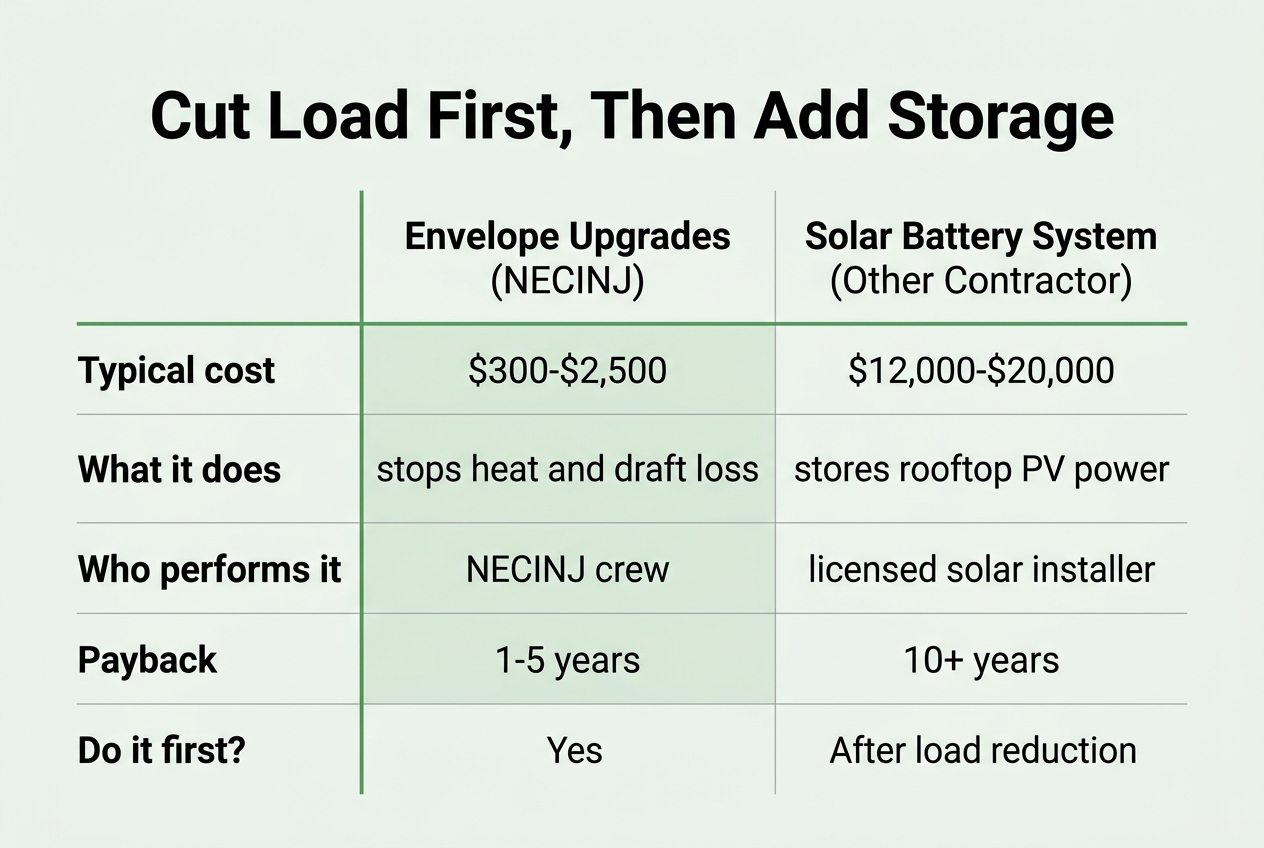
Trim the load first and the whole project gets cheaper. Air sealing, attic insulation, LED swaps, plus practical energy saving tips for summer that flatten peak demand — all of it lowers the capacity you’re paying to store. Smaller load, smaller battery, smaller bill.

How Home Batteries Actually Work With a Rooftop PV System
A home storage setup has five parts worth knowing. The battery module itself. A battery inverter that turns DC power into the AC your outlets use. A critical loads subpanel. An automatic transfer switch that senses when the grid drops. And a monitoring app on your phone. That’s it. Everything else is wiring and labeling.
Systems come in two flavors. DC-coupled setups tie the panels and battery together before the inverter, which is slightly more efficient because power gets converted once. AC-coupled setups bolt onto an existing solar array that already has its own inverter. Retrofits are almost always AC-coupled, since swapping out a working solar inverter to gain a few percent rarely pays. Reviewing how residential storage adoption has shifted helps explain why retrofit-friendly designs now dominate the market.
Critical loads panels and what stays on during an outage
Backing up a whole house sounds great until you price it. Most installers instead move selected circuits into a critical loads subpanel: the refrigerator, a few lighting circuits, the furnace blower or boiler controls, internet gear, and a couple of bedroom outlets. When the grid fails, the transfer switch isolates that subpanel and the battery feeds it.
Whole-home backup needs a much larger battery, a bigger inverter, and often panel work by a licensed electrician. Going fully off-grid in suburban New Jersey is rarer still — you’d need two to four times the storage, oversized solar, and a generator for January. The grid is cheaper than the batteries you’d buy to abandon it. Most homeowners land on grid-tied with backup, and they’re happier for it.
Capacity, output, and the limits of a single battery
Two numbers define a battery, and people mix them up constantly. Usable capacity in kilowatt-hours tells you how long it runs; a 13.5 kWh unit usually delivers about 12.5 to 13 kWh after reserves. Continuous output in kilowatts tells you how much it can run at once — often 5 to 7.6 kW, with a brief peak rating for startup surges.
Central air is where that ceiling bites. A 3-ton condenser can spike well above 10 kW on startup, so it usually needs a high-output system, two stacked batteries, or a soft-start device on the compressor. Before adding capacity, ask which projects to improve energy efficiency would shrink the load instead, and weigh that against insulation and air sealing work that cuts cooling demand all year. Smaller loads mean smaller batteries.
How to Vet a Solar Battery Storage Installer Before You Sign
Battery work sits between two trades, and the company selling isn’t always the company installing. Ask directly who’s on the roof, who’s in the panel, and whose name is on the permit. Then verify the paperwork yourself. It takes about ten minutes online.
- New Jersey Home Improvement Contractor registration — every legitimate firm carries a 13VH number, and you can look it up through the Division of Consumer Affairs before the first site visit.
- A licensed electrician on staff or subcontracted for the service panel tie-in, since battery installs almost always touch the main panel or add a backup subpanel.
- NABCEP certification for the lead technician, plus manufacturer training for the exact brand being installed — Tesla, Enphase, and FranklinWH all run separate certification tracks, and a Powerwall credential doesn’t cover an IQ Battery.
- A written answer on who files the PSE&G or JCP&L interconnection application and who pulls the municipal electrical permit, with a realistic timeline — six to twelve weeks from contract to permission-to-operate is normal, not fast.
- A load calculation and a modeled outage scenario, not just a kWh figure — you want to see which circuits stay live for how many hours with your actual refrigerator, well pump, and sump on the list.
Equipment and installer quality vary wildly, so comparing solar panel service options near Pine Brook helps you judge whether a quote fits the local market. It’s also fair to review a contractor’s background and service history before you hand over a deposit.
Licensing, permits, and interconnection responsibility
Red flags are loud once you know them. Pressure to sign the same day. Vague “whole-home backup” promises with no circuit list. No site visit before a firm price. Financing terms buried on page eleven. Any one of those is reason enough to walk.
Warranty and service commitments worth putting in writing
Separate the three layers: battery cells (usually a 10-year throughput or cycle guarantee), the inverter, and the installer’s own workmanship labor. Cell coverage means nothing if nobody’s paid to come pull the unit off your wall. Get the monitoring plan and a stated response time for a failed battery under warranty — in days, in writing, signed.

Battery Brands, Specs, and Price Ranges to Compare
Quotes get easier to read once you know what the numbers mean. Here’s how four commonly installed home batteries stack up on the specs that actually change your experience during an outage — usable capacity, continuous output, coupling type, and warranty term.
| Battery | Usable kWh | Continuous output | Coupling | Warranty |
|---|---|---|---|---|
| Tesla Powerwall 3 | 13.5 kWh | 11.5 kW | DC (integrated inverter) | 10 years |
| Enphase IQ Battery 5P | 5.0 kWh | 3.84 kW | AC | 15 years / 6,000 cycles |
| FranklinWH aPower 2 | 15.0 kWh | 10 kW | AC | 12 years |
| SolarEdge Home Battery | 9.7 kWh | 5 kW | DC | 10 years |
Installed cost in New Jersey usually lands between $12,000 and $18,000 for a single unit, all-in. A second battery normally costs less per kWh — the electrical work, permitting, and gateway are already paid for, so you’re mostly buying hardware. Expect maybe 25–35% savings on that second unit. The federal residential clean energy credit has covered a share of qualifying storage costs, but rules shift, so confirm current eligibility with a tax professional before you count on it.
Placement matters more than people expect. Most units tolerate roughly -4°F to 122°F, but steady heat shortens life, so a conditioned garage beats a sun-baked south wall. Manufacturers also require clearance — often 6 to 12 inches on the sides and 3 feet of working space in front. For the full picture on the panel side of the project, this solar panel installation guide for New Jersey covers what pairs with storage. One caveat: this comparison is buyer education only. Battery and PV work belongs to a licensed solar contractor, not an efficiency company — and we’d rather say that plainly than blur the line.
Before sharing quote details or usage data with anyone, skim their privacy policy so you know how your information gets handled. Utility bills reveal a lot about a household.
Cut Your Load First: The Energy Audit Step Most Homeowners Skip
Here’s the math nobody puts on a quote sheet: every kWh you stop wasting is a kWh you never have to buy a battery to store. Batteries are priced by capacity. Cut your daily draw by 20%, and the backup system that covers your essentials gets smaller — and cheaper. Efficiency work costs a fraction of storage per kWh avoided. That’s the whole argument.
What a personalized audit documents
A good home energy audit isn’t a walk-through with a clipboard. It measures air leakage, checks insulation depth and coverage in the attic, logs the draw of major appliances, tallies your lighting load, and looks at how much hot water your household really uses. You end up with numbers, not guesses.
Sequence matters. Call a solar or battery contractor first and they’ll size the system around your current bills — waste included. Do the audit first and the sizing reflects a lower load. Same goes for mechanical work; whether you’re weighing a replacement system or reading up on sizing cooling equipment for new construction, the load calculation drives everything downstream.
One thing to be clear about: an energy audit is not a real estate home inspection. It won’t satisfy a lender, won’t flag code violations, and doesn’t replace a licensed inspector’s report at closing. Two different documents, two different purposes.
Envelope and fixture upgrades that shrink the system you need
Attic insulation, caulking, and weatherstripping are the unglamorous core. They lower heating and cooling demand every month of the year, and they don’t need a permit or an inverter. Drafts around doors and old window frames leak conditioned air nonstop — sealing them is cheap and immediate.
Then the fast stuff. LED bulb swaps cut lighting load right away, and showerhead and aerator replacement trims hot water use without anyone noticing a weaker shower. Gas leak testing and repair belongs in any whole-home review too — that’s safety, not savings, and it’s worth asking about when you set up a visit through a provider’s contacts page.
Right Contractor, Right Job: Who Handles What in an Efficiency-Plus-Storage Project
Trade-by-trade responsibility table
A storage project usually touches four or five trades, and mixing them up costs money. Before you start calling anyone, get clear on which license actually covers the work you need. Federal guidance in the Homeowner’s Guide to Solar is a solid starting point for understanding how PV and battery scopes are defined, and it’ll help you read a proposal critically.
| Your goal | Who does it | Envelope-side alternative to the same goal |
|---|---|---|
| PV panels and battery install | Certified solar installer | Cut the load first so you size a smaller system |
| Service panel upgrade, new circuits, EV charger | Licensed electrician | LED bulb swaps and light home repair reduce small draws |
| Central AC, furnace, or heat pump | Licensed HVAC contractor | Attic insulation plus caulking and weatherstripping shrink the load |
| Duct sealing or duct cleaning | HVAC specialist | Air sealing the envelope stops conditioned air loss another way |
| Radon testing and mitigation | Certified radon professional | None — natural gas leak detection and repair is a separate hazard entirely |
Sequencing so no work gets undone
Order matters more than most homeowners expect. An active roof leak goes to a roofer first, because new attic insulation under a leak turns into wet, worthless material fast. Mold is next in line: a certified remediator removes it, then air sealing and attic insulation can address the moisture-driving condition so it doesn’t come back. Window and wall-cavity retrofits belong to other trades. Sealing around existing windows and doors still cuts air leakage for a fraction of the price — it just doesn’t upgrade the glass.
So where does an energy conservation company fit? Appliance replacements, gas leak repair, attic insulation, air sealing, fixture and bulb swaps, and light home repair is a useful catch-all for the small fixes that keep tripping up bigger jobs. That’s the efficiency half. The solar contractor handles the rest.
Your Step-by-Step Plan and What Free NJ Program Services Can Cover
The five-step sequence
Order matters here. Size a battery around today’s wasteful usage and you lock yourself into paying for kilowatt-hours you didn’t need. Work the sequence below and the equipment gets smaller, cheaper, and easier to justify.
- Schedule a home energy audit first and insist on documented numbers — blower-door leakage in CFM50, attic R-value readings, and a month-by-month kWh profile from your utility bills.
- Complete the envelope and fixture work the audit flags: attic insulation to code depth, caulking at window and door perimeters, weatherstripping on exterior doors, LED bulbs throughout, plus low-flow showerheads and faucet aerators.
- Replace failing gas appliances, boilers, or water heaters, and resolve every combustion or leak finding — a licensed tech handling gas leak repair should sign off before anything else moves forward.
- Collect two or three storage proposals built on your post-upgrade usage, then compare them on usable kWh, continuous and surge output in kW, and warranty terms measured in both years and throughput cycles.
- Get permits, utility interconnection filing, and a commissioning date in writing before any deposit clears. No written dates, no deposit.
Research on how Solar PV-Battery-Electric Grid systems perform together confirms what installers see in the field: lower household demand shrinks the storage you need to buy.
Checking eligibility for no-cost services
The New Jersey Comfort Partners Program delivers qualifying efficiency services at no cost to income-eligible households. It isn’t rebate paperwork you file later — it’s participation, and eligibility screening is the doorway. Households already on certain utility assistance programs often qualify. Contractors in Pine Brook at 16 Chapin Rd., Suite 910, reachable at +1 973-244-2400, can walk you through screening, and a skilled team that works efficiently makes that first visit painless.
Before you commit to a duct cleaning or sealing contractor, it’s worth asking how much of your comfort problem actually lives in the ductwork versus the building envelope around it — a drafty attic hatch, unsealed window trim, or thin insulation can undo the gains from even the most meticulous duct work. Get clear on what a company will measure before and after, whether their scope addresses the leaks you can feel as well as the ones hidden in the system, and how they’d prioritize the work if the budget only covers part of it. A skilled team should be willing to tell you which fix returns the most efficiency for the money, even when that fix is caulking, weatherstripping, and attic insulation rather than the job you first called about.
