


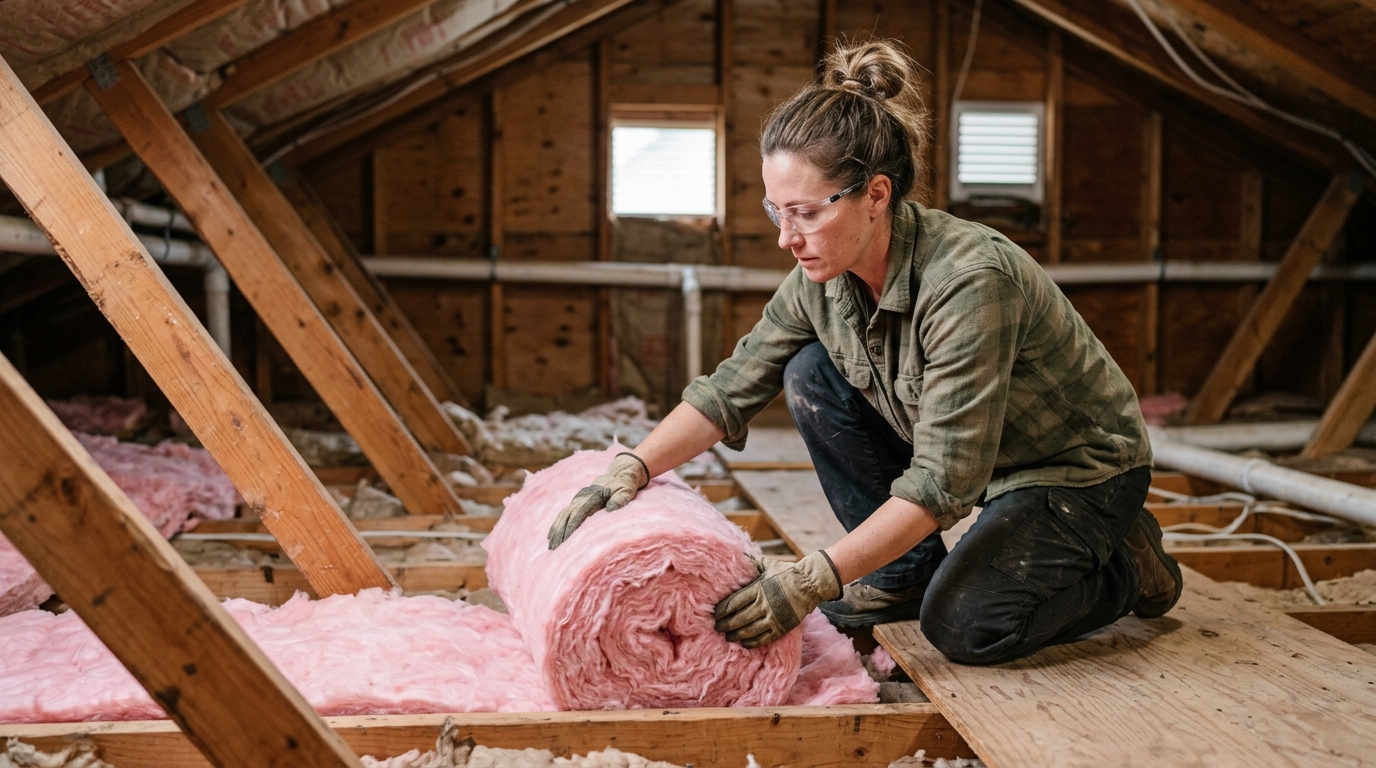
Your attic might be the reason your energy bills keep climbing. If you’ve been researching insulation options, you’ve probably come across r15 insulation and wondered whether it’s enough for your home. Fair question. This article breaks down what that R-value actually means for New Jersey attics, where it falls short, and how NECINJ’s skilled team evaluates your space to recommend insulation that genuinely improves comfort and efficiency — not just a number on a package.
What Is R15 Insulation
Where the R-Value Number Comes From
R-value measures how well a material resists heat flow. The higher the number, the harder it is for heat to pass through — simple as that. It works both ways, too. Good insulation keeps summer heat out just as well as it keeps winter warmth in. Manufacturers test materials under controlled lab conditions to assign these ratings. That’s why you’ll see them printed right on the packaging of batts, rolls, and blown-in bags at any home improvement store.
R15 is a mid-range rating, commonly made from fiberglass or mineral wool batts sized to fit standard 2×4 wall cavities. It’s thinner than the batts built for attics, which need more depth to hit higher numbers. That’s the key distinction: the same “R15” label means something different depending on where it’s installed. A wall cavity is shallow by design, so R15 often represents close to the maximum that space can hold without switching materials entirely.
Why R15 Shows Up in Product Listings
You’ll see R15 everywhere because it’s a practical fit for standard framing, not because it’s some universal target. Retailers stock it heavily for wall projects, and that volume makes it show up first in search results and store aisles. But attics are a different story. Most current code recommendations call for R38 to R60 in attic spaces, depending on your climate zone. R15 alone falls well short for ceiling or attic applications in nearly every part of the country.
This mismatch causes real confusion. Someone shopping for attic upgrades grabs R15 because it’s affordable and well-reviewed, then wonders why their energy bills barely budge. The number alone doesn’t tell you if it’s the right number for the space. Reading up on our services or similar local offerings can clarify which R-value actually applies to your project before you buy anything.
What matters more than chasing a specific rating is knowing your home’s actual gap between what’s installed now and what your attic needs. A thorough assessment, including attic insulation evaluation, measures existing depth and coverage against code targets for your zone. Skip that step, and even a stack of R15 batts might leave you under-insulated and no wiser about why.
R13 vs R15 vs Higher R-Values: Comparing Your Options
Matching R-Value to the Area of the Home
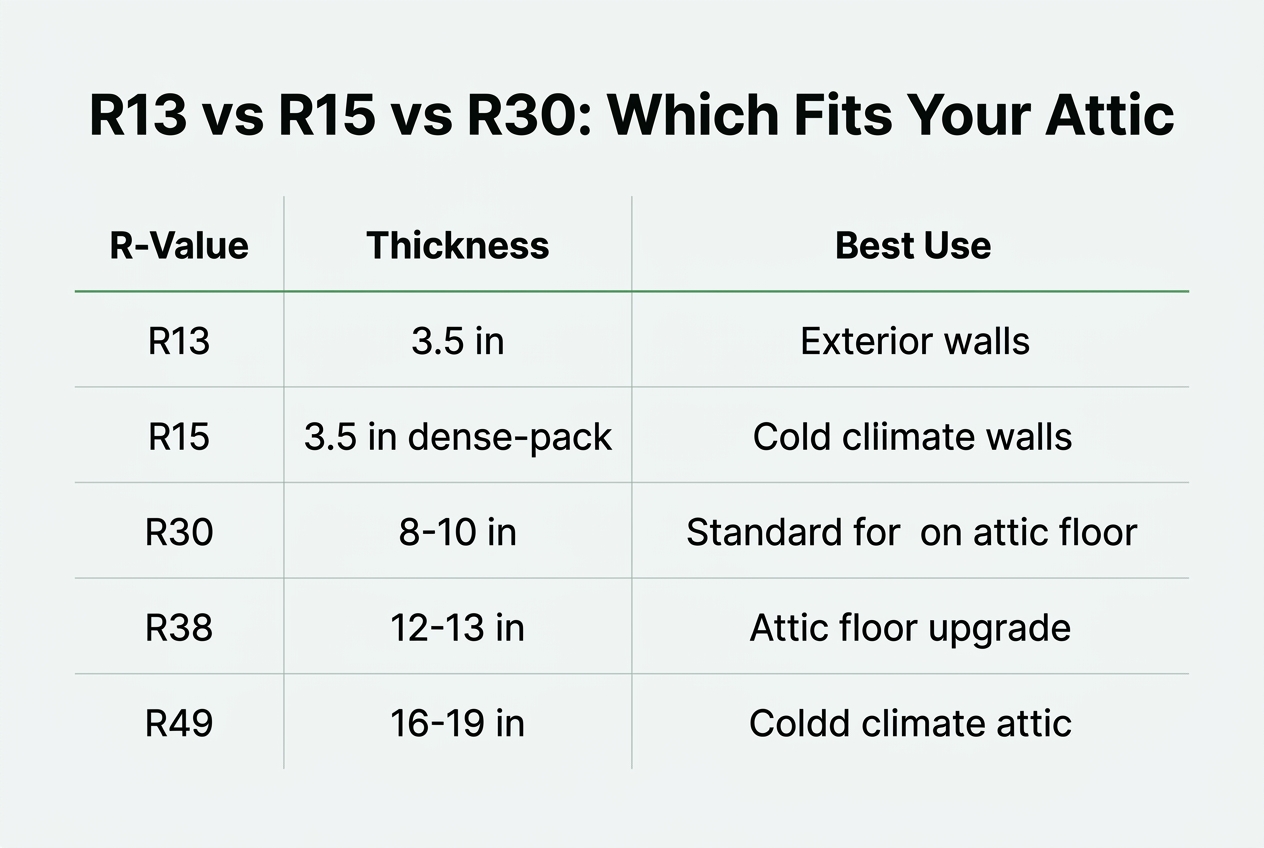
R-values aren’t one-size-fits-all. Each rating was designed with a specific cavity depth and location in mind. Mixing them up wastes money or leaves gaps in protection. Here’s how the common batt ratings stack up against their typical jobs around the house.
| R-Value | Typical Thickness | Common Use | Best Fit |
|---|---|---|---|
| R13 | ~3.5 in | 2×4 wall cavities | Standard exterior walls, mild climates |
| R15 | ~3.5 in (denser batt) | 2×4 wall cavities | Walls needing a slightly higher rating without changing stud depth |
| R21 | ~5.5 in | 2×6 wall cavities | Thicker walls, colder regions |
| R38 | ~10-13 in | Attic floors | Moderate climate zones, standard attics |
| R49-R60 | ~14-19 in | Attic floors | Cold climate zones, aggressive energy goals |
R13 and R15 are wall-cavity staples, not attic solutions on their own. They’re built for the shallow space between studs, not the open, sprawling floor of an attic. That’s why attics generally need R38 to R60 depending on your climate zone — something a wall batt was never engineered to deliver. Try to stretch a wall product to cover a roofline and you’ll end up thin on protection exactly where heat loss is worst.
Here’s the catch as you climb the scale: returns shrink fast. Going from R13 to R38 makes a real dent in your heating bill. Going from R49 to R60 saves less and costs more per inch. At some point you’re paying for thickness, not performance. A proper energy audit measures existing coverage before anyone recommends a number, and reviewing honest research on are solar panels worth it follows the same logic — bigger isn’t automatically better once a system meets the actual need.
Does Your Attic Already Have Enough Insulation
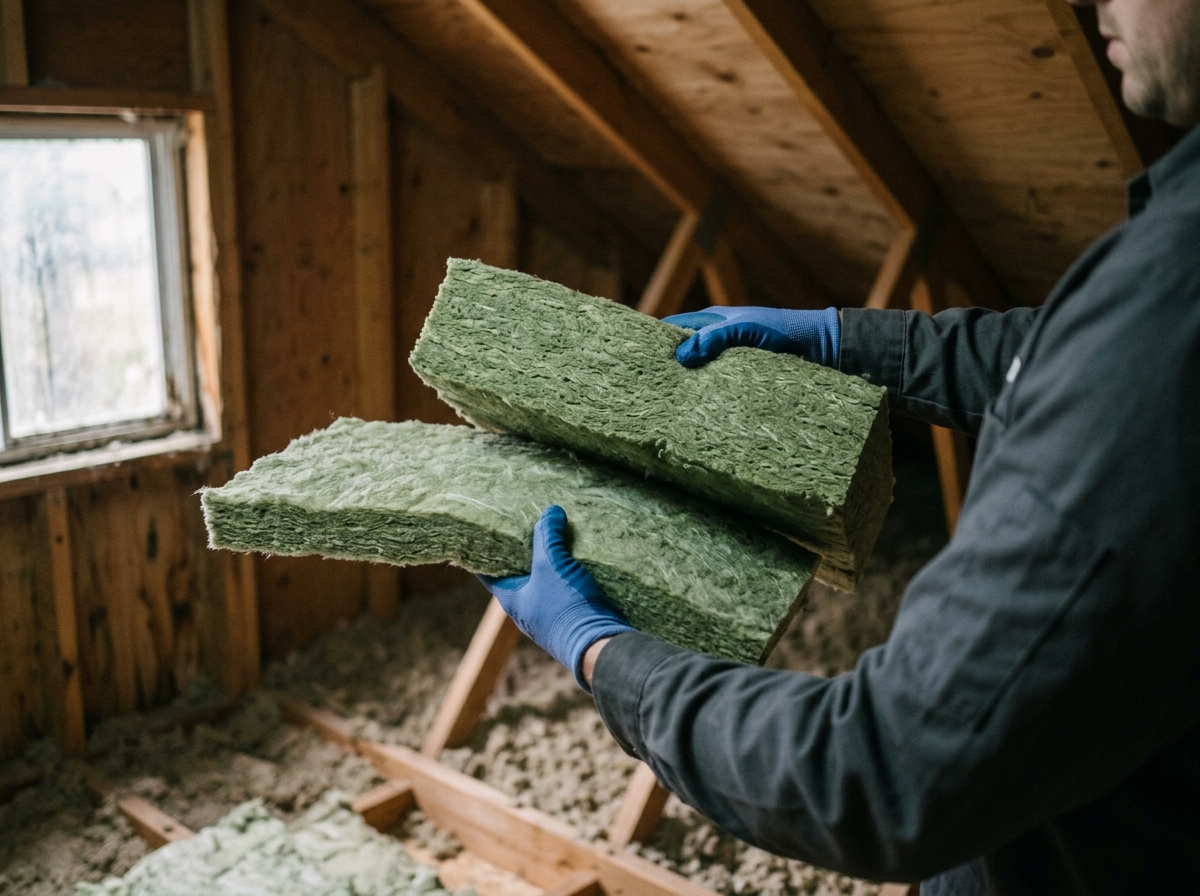
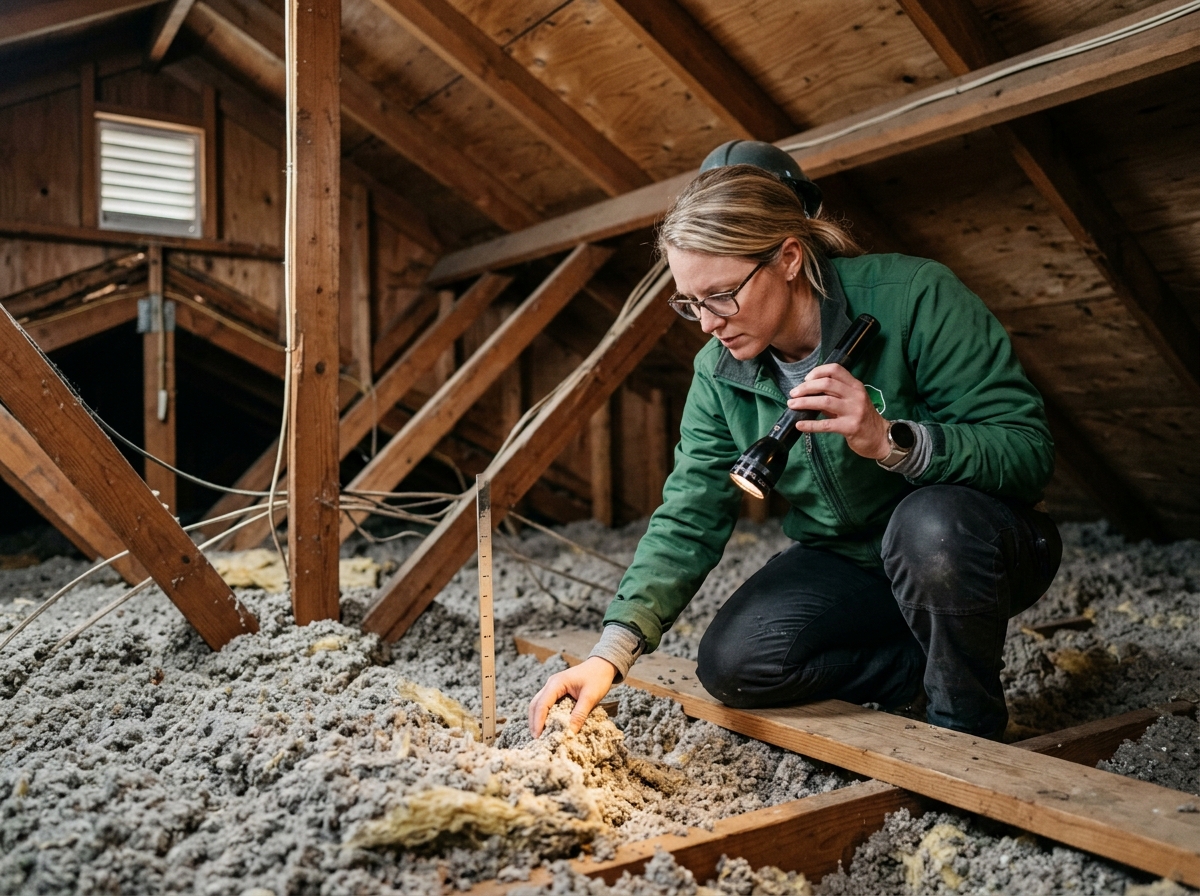
Before you buy a single bag of insulation, climb up and look. Can you see the tops of your joists poking through? That’s a bad sign. Insulation should bury them completely. Thin, compressed, or matted-down batts are another red flag — insulation loses its R-value once it’s crushed or wet, even if it’s still technically there. In winter, check your roofline after a snowfall. Even melting across the whole roof usually means heat is escaping straight through the attic, while snow that stays put on a neighbor’s roof points to insulation actually doing its job.
Ice dams along the eaves and drafty second-floor rooms are two more warning signs worth taking seriously. Ice dams form when attic heat melts snow near the ridge, which then refreezes at the colder edge. That trapped water can back up under shingles and ruin a ceiling. A drafty upstairs in July or January, despite a working HVAC system, usually traces back to the same source. If you want a seasonal gut check on what your home should feel like, energy saving tips for summer offer a useful baseline for comparison.
Here’s the honest truth: eyeballing an attic only gets you so far. A real energy audit measures actual R-value gaps, air leakage, and heat loss with tools like blower doors and infrared cameras — not guesswork. Guessing almost always ends badly, either overspending on material you don’t need or underinsulating and wondering why bills stayed high. An assessment, not a tape measure, is what tells you the truth.
Steps to Improving Attic Insulation the Right Way
Why Air Sealing Comes Before Adding Insulation
Here’s the mistake most homeowners make: they buy insulation first and skip the diagnosis. That’s backwards. Insulation slows heat transfer, but it does nothing to stop air from leaking through gaps around pipes, wiring, and attic hatches. Pour new material over those leaks, and warm or cool air just keeps escaping right under it. Air sealing has to happen first, every time, no exceptions.
A proper upgrade follows a sequence, and skipping steps costs you money later. Here’s the order that actually works:
- Schedule a whole-home energy audit so a trained technician can pinpoint exactly where heat is escaping, using tools like blower doors and infrared cameras rather than guesswork;
- Address air leaks first with caulking around penetrations and weatherstripping on attic hatches and doors, since sealing gaps before adding material prevents wasted insulation;
- Determine the right insulation type and thickness for your specific attic based on what the audit found, since a cathedral ceiling and a flat attic floor rarely need the same approach;
- Install attic insulation to close the exact gap the audit identified, rather than just piling on extra material and hoping for the best;
- Recheck appliances, water heaters, and lighting afterward, because a tighter attic changes your home’s overall load and may reveal other inefficiencies worth fixing.
That last step surprises people. Once your attic stops leaking conditioned air, your heating and cooling systems work less hard, which can shift how efficiently your water heater or older appliances perform by comparison. For a broader look at how these pieces connect, this rundown of projects to improve energy efficiency walks through related upgrades worth considering alongside insulation. Do the steps in order. Your wallet will notice.
R15 Insulation for Walls vs Other Parts of the Home
Attic Insulation as the Highest-Impact Upgrade
Every part of your house wants a different R-value, and that trips people up constantly. Walls, ceilings, floors, and small mechanical closets all lose heat differently, so they’re each rated differently. R15 batts are sized for a standard 2×4 wall cavity. That’s their job. They’re not designed to sit flat across open attic floor joists or stuff into a cramped crawl space, even though homeowners often assume one batt fits all.
Below-grade rooms and anything refrigerated or mechanical — think basements, utility rooms, spaces near a furnace or water heater — follow their own insulation standards entirely, often outside what a typical residential insulation job even touches. Mixing these up wastes money. A batt rated for a wall won’t perform the same wedged under a slab or wrapped around ductwork in an unheated space, and manufacturers don’t intend it to. If you’re unsure which product fits your situation, solar panel service near me pine brook searches and insulation searches both tend to turn up generic advice. It’s worth confirming specs against your actual cavity depth first.
This is where an energy audit earns its keep. A trained technician can document heat loss room by room, attic to basement, even in areas outside a given contractor’s direct service lineup. You get a real map of the problem instead of a guess. Attic insulation consistently delivers the biggest return of any single upgrade, since heat rises and escapes through the roof first. Starting there, backed by audit data, just makes financial sense before touching walls or anywhere else.
Common Insulation Upgrade Mistakes to Avoid
Adding insulation sounds simple. Buy some batts, roll them out, done. But a few avoidable mistakes turn a smart upgrade into wasted money, and they show up in the same order almost every time.
- Skipping the audit and guessing at the material or thickness your attic needs, which often leads to under-insulating cold spots or over-spending on areas that didn’t need help in the first place.
- Ignoring existing air leaks around doors, windows, and attic hatches before insulating — if warm air is still pouring out through gaps, new material just sits on top of the problem instead of solving it.
- Assuming a roof leak or moisture problem will quietly resolve itself once insulation goes in; it won’t, and wet insulation loses most of its effectiveness while inviting mold and rot.
- Overlooking old appliances and leaky fixtures that waste energy no amount of attic work can fix, since a failing water heater or an old showerhead keeps draining your budget regardless of R-value.
- Skipping a check for income-eligibility before paying full price, when programs exist specifically to cover upgrade costs for qualifying households.
That first mistake deserves a second look. Homeowners often treat insulation as a one-size material, when really it’s a calculation. An audit measures heat loss directly rather than relying on guesswork, and it’s worth understanding how solar energy maintenance costs factor in too, since a tighter attic reduces the load any future system would need to cover. Skip that step, and you’re not upgrading your home — you’re gambling on it.
When Insulation Alone Isn’t the Fix: Related Home Issues
Getting Professional Help for Non-Insulation Issues
R15 batts can only do their job if the rest of the house is ready for them. Sometimes the real fix isn’t more insulation at all. It’s whatever’s happening underneath or around it. Get that handled first, and the insulation work you eventually do will actually last.
| Issue | Who Handles It First | Where Insulation Work Fits In |
|---|---|---|
| Active roof leak | Licensed roofer | Insulation goes in only after the leak’s fixed — wet material is ruined material |
| Mold or trapped moisture | Certified remediator | Air sealing and insulation address the moisture-driving condition afterward, not the mold itself |
| Failing furnace, AC, or heat pump | Licensed HVAC contractor | Insulation and air sealing cut the load so the new system runs more efficiently |
| Drafty old windows | Window replacement contractor (if upgrading glass/frames) | Caulking and weatherstripping cut drafts around existing frames in the meantime |
| Suspected gas leak | Gas safety technician | Handled entirely separately — testing, detection, and repair, no insulation involved |
A roof leak is the clearest case. Send a crew up to insulate over a wet deck, and you’ve wasted the material and your money. Water and insulation don’t mix. Mold works the same way: a certified pro removes it, then sealing and insulation help keep the moisture that caused it from coming back. Old double-hung windows are an honest tradeoff, too. You’re not getting new glass out of an insulation job, but tightening the frame with caulk stops a surprising amount of airflow for very little money. Gas is its own lane entirely, and any concern there deserves gas leak repair handled on its own terms, fast and separately from attic work. Same logic with HVAC: a failing system needs a licensed contractor, full stop. But a tighter attic means whatever gets installed next won’t be working overtime to compensate.
Finding Affordable R15 Insulation Upgrades Through Local Programs
Checking Eligibility Before You Buy Materials Yourself
Before you drive to a hardware store and load up on batts, it’s worth finding out if you even have to pay for them. Income-eligible homeowners and renters across New Jersey may qualify for no-cost efficiency upgrades through the NJ Comfort Partners Program, which covers attic insulation along with other energy-saving work. That’s a different path than chasing down utility rebates on your own. Eligibility screening replaces hours of separate paperwork research. You answer a few questions about household size and income, and the program tells you what’s covered.
This matters because R15 isn’t a one-size answer. A personalized energy audit looks at your actual attic, your appliances, and where air is leaking before anyone recommends insulation, appliance replacement, or air sealing. Sometimes insulation isn’t even the first problem. A drafty attic hatch or failing weatherstripping can undo the benefit of new material fast. Many local businesses skip this step and just sell insulation; a proper audit won’t.
A team based in Pine Brook, NJ, works directly with homeowners in the surrounding towns, which means someone familiar with older Northeast housing stock is doing the assessment, not a call-center scheduler. If a home also needs a struggling refrigerator or water heater swapped out, home appliance replacements can be bundled into the same visit for efficiency gains beyond the attic. To find out where you stand, call +1 973-244-2400 or stop by 16 Chapin Rd., Suite 910, Pine Brook, NJ 07058, to set up an assessment. It costs nothing to ask.
Knowing the R-value you’re starting with matters more than chasing a number off a chart, since the right depth really depends on what’s already up there and how much has settled or gaps over time. A skilled team looking at the attic firsthand tends to catch what a quick measurement misses, which is part of why so many people mention efficiency and the job itself when they talk about getting this right. NECINJ’s work in Attic Insulation is one piece of that picture, and from here the most useful thing is simply learning the current state of the space before deciding what R15 or any other rating should mean for this particular home.
