


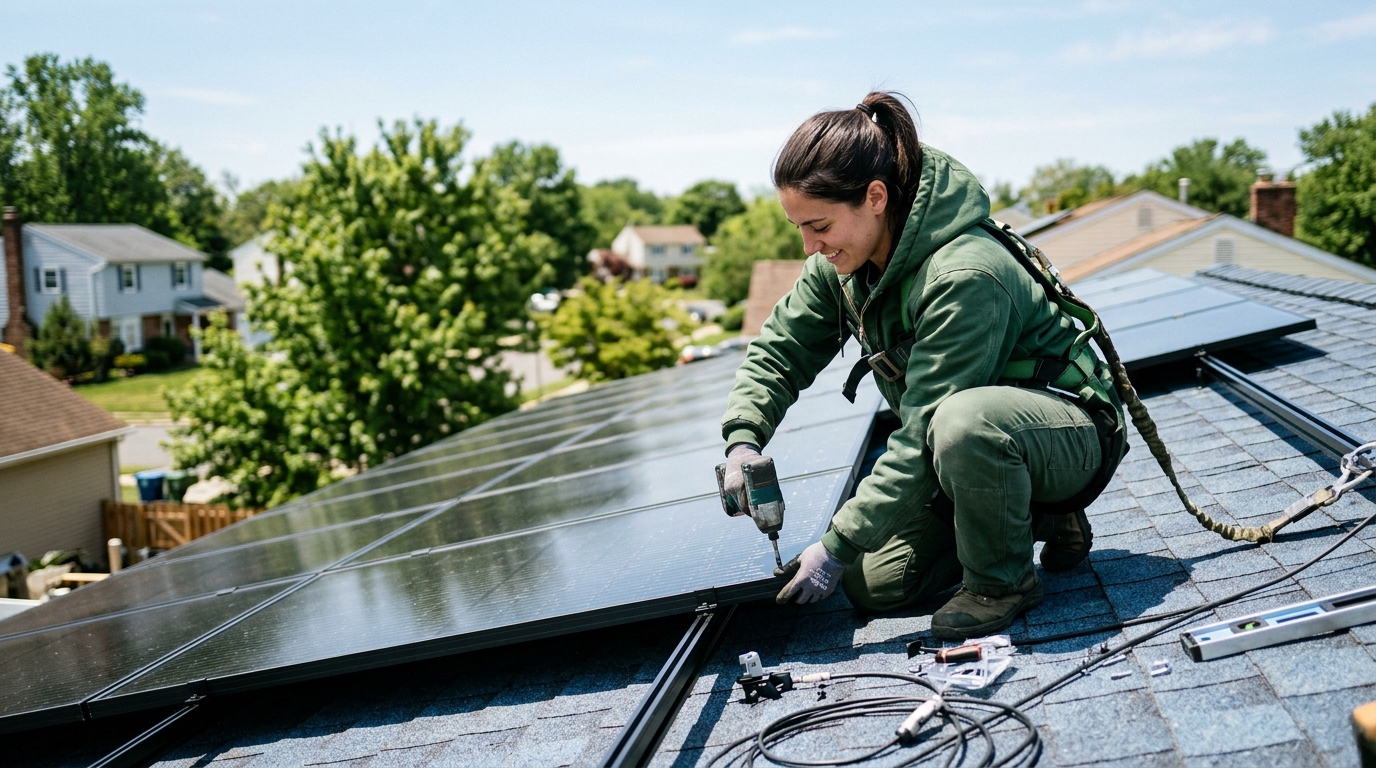
You’ve seen the ads promising thousands in savings, but you’re still wondering if solar panels are worth it for your New Jersey home. It’s a fair question. Rising electric bills make the pitch tempting, yet the real answer depends on your roof, your usage, and the incentives you actually qualify for. So does solar panels save money for homeowners in your situation? Let’s break down what actually determines your return before you sign anything.
Does Solar Panels Save Money for New Jersey Homeowners
Why the answer isn’t the same for every home
Short answer: yes, for most New Jersey homes. Solar panels typically pay for themselves in 6 to 10 years, depending on your usage patterns and which incentives you qualify for. After that, you’re generating power at a fraction of what the utility would charge. It’s not instant, and it’s not magic. But over a 20-to-25-year panel lifespan, the math works out favorably for the vast majority of homeowners across the state.
The savings come from three places working together. First, lower monthly utility bills, since you’re pulling less power from the grid. Second, New Jersey’s SREC-II incentive program, which pays you for the clean energy your system produces. Third, net metering credits, which let you bank excess solar production and offset what you draw at night or during cloudy stretches. Stack all three, and the numbers move quickly in your favor. For a deeper breakdown of whether the investment fits your situation, are solar panels worth it is worth a look.
Here’s the catch, though: your savings depend heavily on your roof’s condition, how efficient your home already is, and your electricity habits before installation. A shaded roof, an aging roof needing replacement soon, or a home that leaks energy through poor insulation and drafty windows will all shrink your return. Solar isn’t a standalone fix — it works best as one piece of a broader energy strategy that includes attic insulation, weatherstripping, caulking, and LED lighting. Skip those steps, and you’re paying to generate power that leaks right back out. The Department of Energy’s own guidance on Will I Save Money with Solar Energy? makes a similar point: your home’s efficiency shapes your outcome as much as the panels themselves. Many local businesses, including providers with a full about us story built around energy conservation, exist precisely because solar works best paired with the rest of the house, not installed in isolation.
What Determines Your Actual Solar Savings
Production versus consumption
Your savings start with a simple question: how much power will your panels actually make? That depends on roof angle, shading from trees or neighboring homes, and the quality of the panels themselves. A south-facing roof with no shade can outproduce a shaded, east-facing one by a wide margin, even with identical equipment. This Can Solar Panels Save You Money? breakdown covers how these variables interact in more detail.
Production is only half the equation. The other half is when you actually use electricity. Panels generate the most power midday, but most households run appliances, lights, and AC heaviest in the morning and evening. If your usage doesn’t line up with production hours, you’ll rely more on the grid or a battery than you might expect. Pairing panels with LED light bulb replacement and efficient appliances helps stretch what you do generate further.
How financing changes your break-even point
How you pay for the system changes everything about your savings timeline. A cash purchase costs more upfront but reaches break-even fastest, since there’s no interest and no lease payment eating into monthly savings. A solar loan spreads the cost out but adds interest, pushing break-even further out. A lease often means little upfront cost but smaller, slower savings, since the leasing company keeps some of the value.
Incentives shift these numbers considerably. The federal tax credit, NJ’s SREC-II program, and net metering agreements can all shorten your payback period, sometimes by years. Before signing anything, compare your last twelve months of bills against a realistic production estimate, not a best-case one. It’s also worth checking window options; the “What Are Solar Shades” guide from a Bergen County window treatment specialist explains a low-cost way to cut heat gain before you even add panels. For homeowners weighing insulation upgrades alongside solar, an insulation cost 2026 pricing guide offers useful context, and details on how personal information is handled during any assessment are outlined in a standard privacy policy.
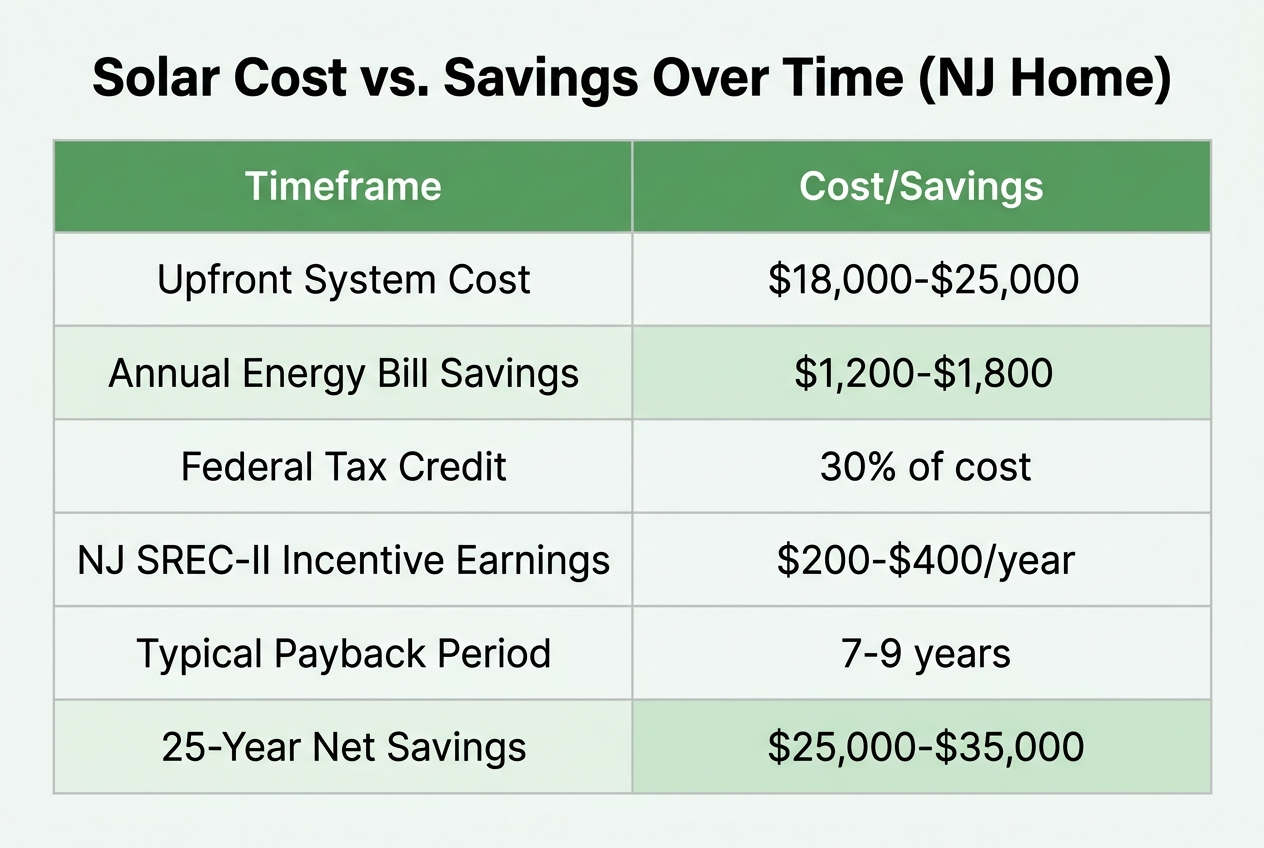
Solar Panel Costs vs. Long-Term Savings
Let’s talk real numbers. A typical New Jersey home needs a 7-8 kW system, and that runs $21,000 to $28,000 before incentives. The federal tax credit knocks 30% off that, bringing your net cost down to roughly $15,000 to $19,600. That’s still a big check to write. But it’s the starting point for every savings calculation that follows, so it matters to get it straight before you commit to anything.
Monthly bill savings vary by home size and usage, but most NJ homeowners see $100 to $180 knocked off their electric bill each month, or $1,200 to $2,160 a year. Paying cash gets you to breakeven faster. Financing stretches it out, since loan interest eats into your monthly savings. How Solar Panels Cut Your Electric Bill breaks down the mechanics of how that offset actually works on your utility statement.
| Payment Method | Net Cost | Avg. Annual Savings | Payback Period | 20-Year Net Savings |
|---|---|---|---|---|
| Cash purchase | $15,000 | $1,800 | ~8.3 years | ~$21,000 |
| Cash purchase (larger system) | $19,600 | $2,160 | ~9 years | ~$23,600 |
| Solar loan (5% APR, 15 yr) | $0 down | $900 net | ~14 years | ~$9,000 |
| Solar loan (7% APR, 10 yr) | $0 down | $600 net | ~16 years | ~$6,500 |
Notice the gap. Cash buyers roughly double their long-term savings compared to loan customers. That’s not a knock on financing — it just means you should run your own numbers before deciding. Small efficiency fixes help either way. Weatherstripping, caulking, and attic insulation all reduce the load your system needs to cover, and cutting your usage first often shortens payback more than people expect. For questions on financing options or getting your home evaluated, contacts is the fastest route to a straight answer.
Why an Energy Audit Should Come Before Solar Installation
How lowering usage first improves solar’s return on investment
Here’s the thing nobody tells you at the sales pitch: solar panels don’t fix a wasteful house. They just power it. If your attic leaks heat all winter and your boiler is twenty years old, solar will dutifully generate electricity to cover that waste, dollar for dollar, forever. Fix the waste first, and every panel you install works harder for you.
Attic insulation and air sealing are the cheapest load-reduction tools around. A poorly insulated attic can account for a huge share of winter heat loss, which often gets made up with electric heat strips or an overworked HVAC system. Seal that up before going solar, and you shrink the system size you actually need. Caulking and weatherstripping around doors and windows do the same job on a smaller scale, but it adds up fast.
Outdated appliances, boilers, and water heaters are quiet money pits. An old water heater running constantly, or a boiler operating at 60% efficiency, burns through energy that no reasonably sized solar array can offset economically — you’d need to way oversize the system just to keep pace. Appliance replacements often make more financial sense than adding panels to compensate.
A professional audit is really a diagnostic exam for your house. It finds the drafts, the leaks, the inefficient fixtures you’ve stopped noticing. Old showerheads, incandescent bulbs, gas leaks nobody knew about — an audit surfaces all of it, and simple fixes like showerhead and aerator replacement or led light bulb replacement often pay for themselves within months, not years.
Right-sizing matters more than most homeowners realize. Install solar before addressing inefficiencies, and you risk buying a bigger, pricier system than your (soon-to-be-lower) usage actually requires. Audit first, upgrade what needs it, then size solar to the real number. For more on getting sequencing right, the blog and the video “Is Solar Worth it for Homeowners? | Unveiling the Real Sa…” both dig deeper into this. Most people skip this step. It shows — on their electric bill.
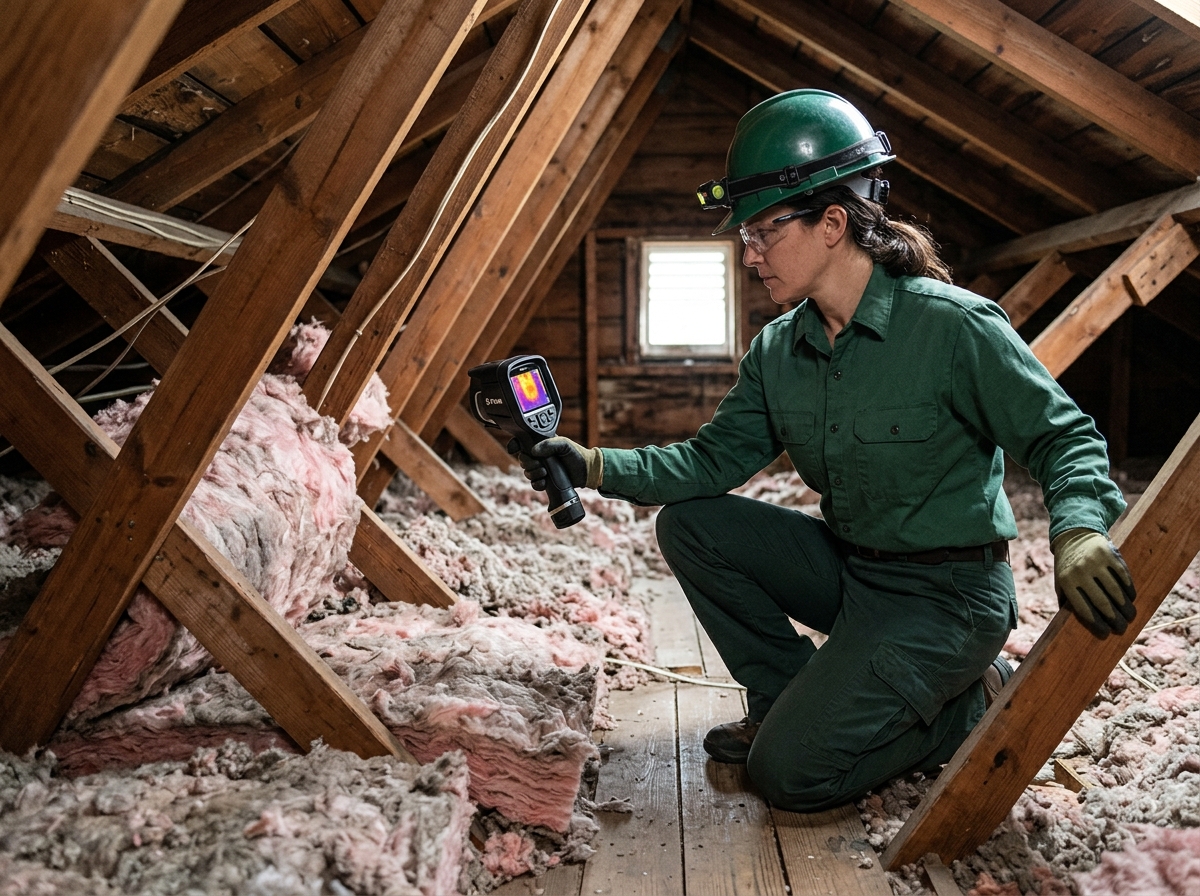
Home Upgrades That Increase Your Energy Savings Alongside Solar
Solar panels only cover part of the picture. If your home leaks air, wastes hot water, and runs on tired appliances, you’re generating clean power just to burn it on inefficiency. That’s backwards. The smarter move is pairing solar with projects to improve energy efficiency so every kilowatt your panels produce actually goes further.
A few upgrades make an outsized difference, and none of them require a huge investment to matter:
- Attic insulation keeps conditioned air where it belongs, cutting the heating and cooling demand your solar system has to offset in the first place.
- Caulking and weatherstripping around doors and windows seal off drafts that quietly inflate winter heating bills and summer AC runtime.
- LED light bulb replacement lowers your baseline electricity use, meaning more of your solar output goes toward bigger loads instead of just lighting.
- Showerhead and aerator replacement reduces the volume of hot water your household uses, which trims water heating costs directly.
- Appliance replacements, including boilers, water heaters, dishwashers, and stoves, swap outdated equipment for efficient models that use less energy to do the same job.
- Gas leak testing and repair keeps your gas-powered systems running safely and efficiently, so nothing’s wasted before it even reaches your appliances.
Curious what this looks like in practice? Browse a portfolio of completed home upgrades for a sense of scope. And if you want the numbers behind pairing efficiency work with solar, this piece on How Much Can You Really Save by Switching to Solar … breaks it down well.
Solar Panels: Pros and Cons Before You Commit
Before you sign anything, weigh both sides honestly. Solar isn’t a bad investment for most New Jersey homes, but it’s not automatically the right move for every roof or every budget. Here’s the breakdown, plain and simple.
| Category | Pros | Cons |
|---|---|---|
| Monthly costs | Lower electric bills, often significantly | High upfront cost, typically $17,000–$25,000 before incentives |
| Long-term value | Protection from rising utility rates; boosts resale value | Financing interest can eat into savings if rates are high |
| Physical requirements | Works great on south-facing, unshaded roofs | Needs specific roof age, angle, and condition |
| Upkeep | Minimal — occasional cleaning | Panel degradation, inverter replacement after 10-15 years |
| Environment | Cuts your carbon footprint measurably | Manufacturing and eventual disposal have their own footprint |
When solar isn’t the best option
Some homes just aren’t good candidates. A heavily shaded roof, surrounded by tall trees, won’t generate enough power to justify the cost. Planning to move in three or four years? You may not stay long enough to recoup the investment. Older roofs needing replacement soon also complicate things — nobody wants to pull panels off twice. If any of that sounds like your situation, it’s worth reading real homeowner experiences like this thread on Solar panels – how much does it save? before deciding.
When solar isn’t feasible yet, efficiency upgrades still save real money. Attic insulation, caulking, weatherstripping, and LED bulb swaps cost far less and pay back fast. Pair that with energy saving tips for summer and you’ll cut bills without a five-figure commitment.
How to Start Saving on Energy Costs Right Away
You don’t need solar panels to start cutting your bills. Most homes waste energy in ways that are cheap and quick to fix. The smart move is to start small, build good habits, and let a professional show you where the real losses are hiding. That starts with an energy audit, and it’s often free.
Free upgrades through the NJ Comfort Partners Program
Income-eligible New Jersey households can get a full slate of upgrades at no cost through a state-run program. It’s designed to cut waste and lower bills without asking homeowners to spend a dime. A visit typically includes:
- A full home walkthrough that checks insulation levels, appliance age, and air leaks around doors and windows
- Gas leak testing and repair to make sure your heating and cooking systems are safe
- Attic insulation upgrades to stop heat from escaping through the roof in winter
- Replacement of old appliances, water heaters, or boilers that are quietly driving up your bills
- Simple fixes like LED bulb swaps, showerhead and aerator replacements, and weatherstripping
Building an energy-efficient home step by step
An audit visit usually takes a few hours. A technician checks your attic, your appliances, your ductwork, and looks for drafts you’d never notice on your own. From there, recommendations get ranked by cost versus payoff, cheapest and highest-impact fixes first. Caulking a drafty window costs little. A new boiler costs more but saves more over time.
This groundwork matters before you even think about panels. You can browse our services to see the full range of upgrades available, and if you’re curious what solar could add on top of an efficient home, this guide on How Much do Solar Panels Save In 2026? is worth a read. To schedule a visit, call +1 973-244-2400 or stop by the Pine Brook office at 16 Chapin Rd., Suite 910.
Before you invest in solar, it’s worth making sure the rest of your home isn’t quietly wasting energy first. The team at NECINJ, based right in Pine Brook, NJ, offers personalized energy audits that pinpoint exactly where your home is losing money, and if you qualify for the NJ Comfort Partners Program, some of these upgrades may even be free. Stop by their office at 16 Chapin Rd., Suite 910, or call +1 973-244-2400 to book an audit and see how much you could really be saving.
